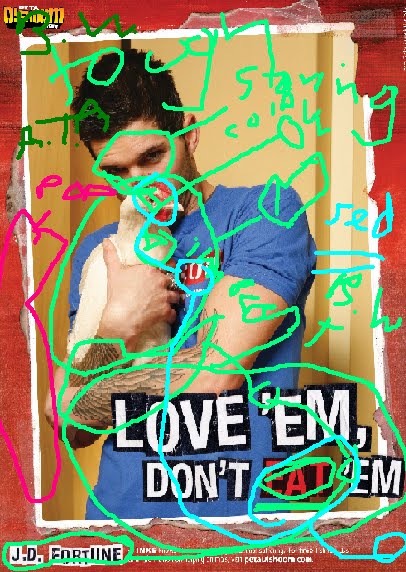
This ad uses 3 different logical fallacies. These three are guilt by association, black or white and appeal to authority. In the ad, you see J.D. Fortune holding a chicken with the words, “Love ’em, Don’t eat ’em” written underneath. When you see the innocent, helpless chicken, you feel guilty for eating meat (unless you’re a vegetarian). This is guilt by association because anyone who eats meat and then sees this poor chicken, would feel guilty for being responsible for ending an animal’s life. The ad uses black or white with the text that is at the bottom of the ad. The text reads: “Love ’em, don’t eat ’em.” These words imply that you either love the animals, or you eat them. The ad presents no alternative or middle ground. So, for example, you can’t love the animals and still eat them. The ad gives you two clear choices and makes you pick one or the other. The third fallacy used is appeal to authority. The man that you see holding the chicken, is J.D. Fortune, formerly of the rock band INXS. By using him in the ad, the producer of the ad is saying that if you want to be like this guy, you should be a vegetarian.
In this ad you see a rocker promoting being a vegetarian. This is an interesting approach, because most people associate vegetarian with “hippie” or “organic hemp” and not “rock.” At the same time, most people would assume that rock stars are all hard core, meat eaters, instead of animal lovers. However, this ad shows that you can be hard core rock and still be an animal lover and vegetarian. This ad is directed to people who love animals and eat meat, by saying that you can’t possibly do both. It also is speaking to people who like to rock and also like animals, to them it says, you can do both. It is kind of ironic that with both audiences the ad it directed at, it is giving off separate messages. To one group it is saying, you have to pick one side or the other, and to the other group it is saying, you don’t have to choose. That is how black or white and appeal to authority and guilt by association all work together to target different groups.
The first thing you see when you look at this ad is J.D. Fortune’s black eyes staring at you. The stare is intense and almost threatening. It makes you wonder why he looks so angry. You then see that his head is bent down, almost pointing to the chicken that he is holding. The chicken looks innocent and maybe a bit scared, and is also staring at you. You feel compassion for the chicken and you also realize that J.D. Fortune also feels compassion for the chicken because he is hugging the chicken and nuzzling it. Your eye then goes to the bold writing at the bottom. The writing is white, outlined in black. This really makes the writing stand out and makes it noticeable. The only exception is the word “eat” which is in red. I think that this word is in read because the producer of the ad wanted to make it very clear that you are eating the chicken. The word “eat” is red outlined in black. Red is also the colour of blood, and that reminds the audience of the blood that has to be spilt in order for you to eat the chicken. This red also matches the parts of the chicken’s head, the writing on J.D.’s shirt and the border. All of this makes the red “pop” and makes it more noticeable.
The use of the border also helps to make the whole ad stand out, and it provides more red, which reminds us of blood. In addition, the background colour, matches the colour of the chicken’s body. This compliments the chicken and helps it to stand out against J.D.’s body. This ad has a common theme, it all looks rather rugged. The border looks like ripped paper, J.D.’s tattoos are very obviously displayed and even the writing. It says “eat ’em” instead of “eat them.” This all add to the “rock and roll” effect. Since the ad matches the rock and roll thoughts we associate with J.D. Fortune, this use of a more jagged feel for the rest of the ad only makes sense. This reinforces the idea that being a vegetarian can be cool and hard core.
As you can see, this ad uses a variety of techniques to relay it’s message, including 3 different logical fallacies.

Subscribe to:
Post Comments (Atom)


This is very detailed analysis. You could probably edit this somewhat. You could just apply the most obvious fallacy or two. Good explanation!
ReplyDelete